
Disclosure: This post contains affiliate links. If you buy through them, we may earn a commission at no extra cost to you. We only recommend storage we’d use in a normal-sized home — and every product suggestion here comes with the dimensions to check before you buy.
The Short Answer
Spice chaos is almost never a space problem — it’s a visibility problem. If you can only see the front row, the other rows might as well not exist, and that’s how you end up with three jars of cumin. The fix is choosing the system that matches your measurements: a tiered riser for standard cabinets at least 10″ deep, an angled drawer insert if you have a drawer 3″ or deeper to spare, a door or wall rack when shelf space is gone, and a turntable for deep or corner cabinets. Measure first, count your jars second, buy third.
Nobody Has a Spice Problem. They Have a Visibility Problem.
Here’s the test: name every spice you own. Not most of them — all of them.
Most of us can’t. We know the front row by heart (garlic powder, paprika, whatever lives closest to the stove), and the back rows are a rumor. So we buy a new jar of chili powder while a perfectly good one sits two rows back, quietly expiring.
Spices are small, numerous, and all roughly the same shape — which means any system that hides some of them behind others has failed at its only job. The four systems below all solve visibility differently: lifting the back rows up, laying everything flat, spreading it across a door, or spinning it into view. Which one is right depends entirely on the size of the space you actually have.
Step 1: Measure Your Space (Before You Look at a Single Rack)
Five minutes, one tape measure. Jot the numbers in your phone:
| Measure this | How to do it | Why it matters |
|---|---|---|
| Cabinet width | Inside wall to inside wall | Systems come in fixed widths (usually 10–24″). A 16″ rack in a 15″ cabinet is a return, not a solution. |
| Cabinet depth | Front edge to back wall | Most upper cabinets are about 11–12″ deep inside. Depth decides whether tiers or a turntable will fit. |
| Shelf spacing | Shelf surface to the underside of the shelf above | Most spice systems need 5–7″ of vertical room once jars stand on them. |
| Drawer width, depth, and height | Inside dimensions, all three | Drawer inserts need a drawer roughly 3″ deep or more, and inserts come in fixed sizes that must match your drawer. |
| Door inside width and thickness | Flat area of the cabinet door | Door-mounted racks typically need 10–16″ of flat width and add about 2–3″ of depth when the door closes. |
Then count. Pull every spice out and make an honest pile. Most households land between 20 and 40 jars — if your pile is 55, no single system below will hold it all, and that’s useful to know before you shop.
The jar math: a typical 4 oz spice jar — the standard grocery-store size — is about 4″ tall and roughly 2″ in diameter (typical range: about 3.75–4.5″ tall, 1.75–2.25″ across). Bulk jars run bigger, roughly 5.5–7″ tall. Every capacity below assumes standard 4 oz jars; if your collection is mostly bulk jars, cut the capacity by a third.
The 4 Systems, Ranked by the Space They Need
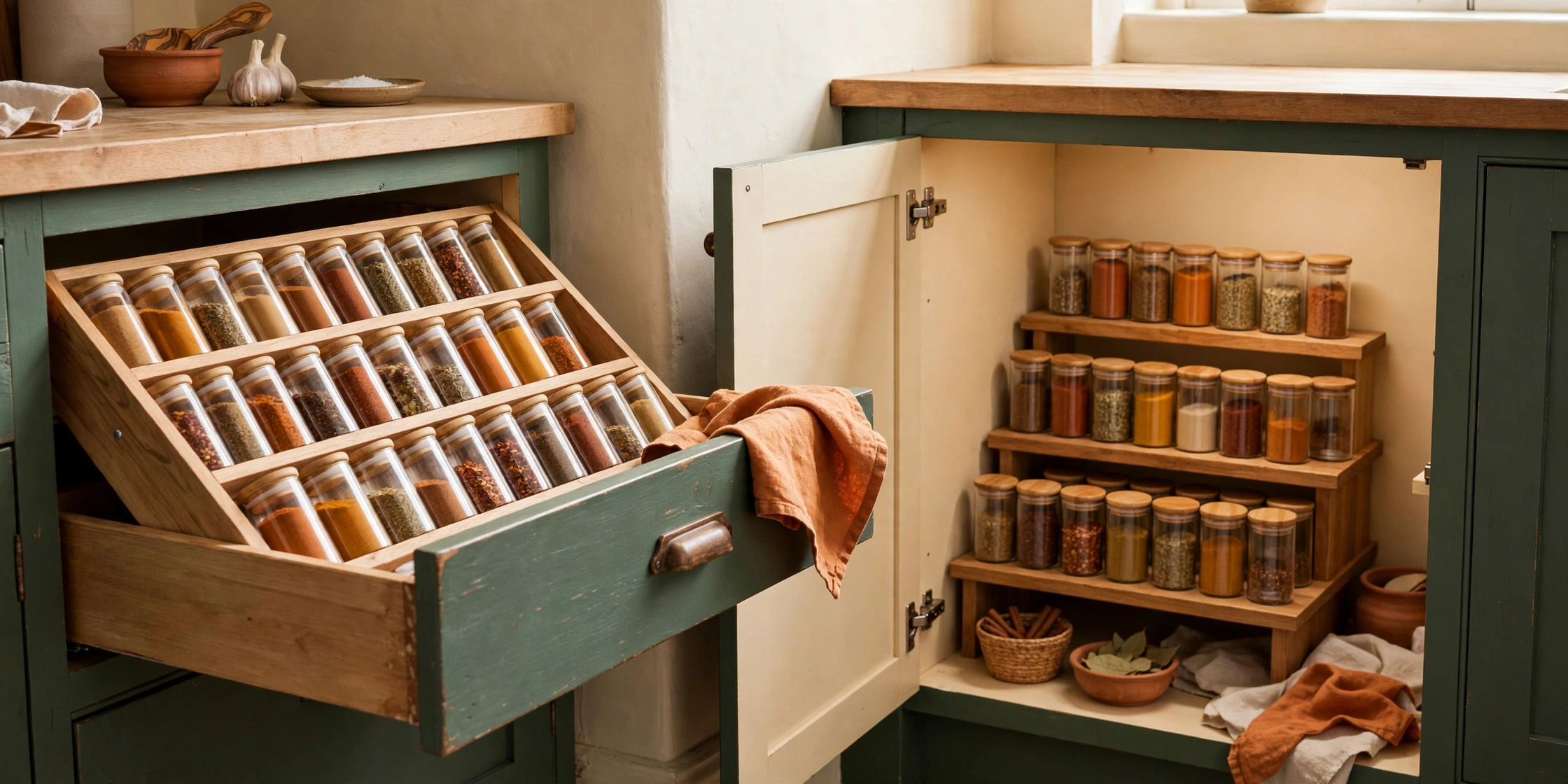
System 1: The Tiered Shelf Riser — Best for Most Standard Cabinets
Needs: a cabinet at least 10″ deep and 12″ wide, with about 6″ of shelf height above it for jars on the top tier.
Realistic capacity: about 18–24 standard jars on a typical 3-tier riser, 12–16″ wide.
Picture stadium seating for spices: two or three steps, back row highest. It’s the classic for a reason — cheap, no installation, works in cabinets, pantries, and on counters.
Visibility strength: good for the top rows — you read the back row’s labels over the heads of the front row.
Failure mode: the front-bottom row. Jars on the lowest step hide behind the cabinet’s face frame on some cabinets, and on deep cabinets (12″+) the riser only fixes the front half — spices still lurk behind it.
tiered spice shelf riser, expandable
3-tier cabinet shelf organizer
Buy it if: you have a normal cabinet, a normal budget, and 25 or fewer everyday spices.
System 2: The In-Drawer Angled Insert — Best Visibility, If You Have the Drawer
Needs: a drawer at least 3″ deep inside (4″ is more comfortable), and an insert sized to your drawer’s inside dimensions — common inserts fit drawers roughly 13–20″ wide and 15–21″ deep, often trimmable or expandable.
Realistic capacity: about 24–36 standard jars in a mid-size drawer, laid in angled rows.
The insert holds jars tilted toward you, labels up, like a spice filing cabinet. Every jar is visible at a glance — genuinely the best visibility of the four systems.
Visibility strength: excellent — the only system where 100% of your collection is visible at once.
Failure mode: it costs you a whole drawer. In a small kitchen, drawers are prime real estate, and giving one up entirely to spices is a real trade. Odd-shaped and bulk jars don’t fit the angled slots and end up exiled to a cabinet anyway, splitting your collection in two.
in-drawer spice rack insert, expandable
bamboo drawer spice organizer insert
Buy it if: you have a spare drawer near the stove and cook with spices daily. This is the cook’s system.
System 3: The Door or Wall-Mounted Rack — Best When Shelf Space Is Gone
Needs: a flat surface. Inside a cabinet door: about 10–16″ of flat width and enough clearance that the rack (roughly 2–3″ deep loaded) doesn’t collide with the shelves when the door closes. Or a stretch of free wall near the stove.
Realistic capacity: about 16–24 standard jars across 3–4 door-mounted rows.
This system creates storage out of nothing — dead door space becomes a spice rack, and your shelves stay free.
Visibility strength: very good. One jar deep, everything facing you, nothing behind anything.
Failure mode: the door itself. Slam it and jars rattle — or worse, a loose jar jumps. Heavy collections can strain hinges over time, adhesive-only versions eventually let go in steamy kitchens (screw-mounted is sturdier), and wall-mounted jars near the stove sit exposed to heat and light, which spices don’t love.
cabinet door spice rack, screw mount
wall mounted spice rack set
Buy it if: your cabinets are full but you’ve got a door or a free wall — classic small-kitchen move.
System 4: The Turntable — Best for Deep and Corner Cabinets
Needs: room for the disc plus spin clearance — a 10–12″ turntable for standard cabinets, up to 18″ for a deep pantry shelf or corner cabinet. Leave about 1″ of clearance all around so it actually rotates.
Realistic capacity: about 10–14 standard jars on a 12″ turntable in a single ring, fewer if you double-ring larger jars in the middle.
The lazy Susan approach: everything on a disc, spin to browse. It’s the only system here that tames a deep cabinet or awkward corner, where a riser’s tiers would be unreachable.
Visibility strength: mixed. One spin shows you everything — eventually. At any given moment, half your spices face away.
Failure mode: the spin giveth and the spin taketh. Jars near the edge topple when you rotate too fast, tall bottles wobble, and a turntable in a shallow cabinet wastes the corners of its shelf (round peg, square hole). Two-tier versions exist, but the lower tier hides under the upper disc — recreating the exact problem we started with.
lazy susan turntable, 12 inch
two-tier turntable organizer
Buy it if: your spice spot is deep, cornered, or otherwise unreachable. It’s a reach fix first and a visibility fix second.
Quick Picks by Cabinet Situation
| Your situation | Your system |
|---|---|
| Standard cabinet, 20–25 jars | Tiered riser |
| Spare drawer near the stove | In-drawer insert |
| Cabinets full, door or wall free | Door/wall rack |
| Deep or corner cabinet | Turntable |
| More than 40 jars | Two systems — daily drivers in a riser or drawer, backstock jars in the pantry |
The Honest Decant-or-Not Take
Should you pour everything into matching jars? Our honest answer: probably not all of it.
Decanting makes sense for exactly two groups: the bulk or club-store spices in containers too big for any system above, and the five or six daily drivers you refill constantly. Uniform jars genuinely help there — same footprint, stackable, easy to label.
Everything else? Original jars are fine. They already have labels and already fit. A full decanting project also has a hidden cost: a second, secret spice collection — the half-empty original bags and tubs living somewhere else, waiting to refill the pretty jars. That’s not organization, that’s a supply chain.
Label So Future You Can See It
Visibility doesn’t stop at the rack:
- Label the top, not just the front. On risers and turntables you read jars from above half the time. A dot of masking tape with the name on the lid makes every system faster.
- Add the year. Spices don’t spoil dangerously, they just fade — most ground spices are past their best after 2–3 years. A small “2026” on the lid tells you when to stop wondering why the chili tastes like dust.
- Keep like with like. Baking spices together, everyday savory together, the hot stuff together. Groups survive; strict alphabetical order collapses the first time someone else cooks.
The Reality Check: How Many Spices Do You Actually Own?
Before any of this, do the count from Step 1 — and be honest about what the pile says. The pattern is remarkably consistent: roughly 10 spices do 90% of the cooking, another 10–15 rotate in monthly, and the rest — specialty blends, one-recipe wonders, souvenir tins — get touched a few times a year.
So don’t buy a system for all 50. Buy for the 20–25 you actually use, in your best-visibility spot, and give the long tail a simple bin in the pantry as backstock. A smaller collection in a system that fits beats a giant one crammed into a system that doesn’t.
FAQ
What’s the best spice organizer for a small cabinet?
A tiered riser, if the cabinet is at least 10″ deep and 12″ wide — it fits most standard cabinets with no installation. Too shallow or narrow? A door-mounted rack moves the whole problem off the shelf.
How many spice jars fit in a standard kitchen drawer?
With an angled insert in a mid-size drawer (about 15–18″ wide inside), roughly 24–36 standard 4 oz jars. The drawer needs to be at least 3″ deep — and measure before ordering, because inserts are sized to specific dimensions and “close” doesn’t fit.
Is a lazy Susan good for spices?
For one specific job: deep or corner cabinets where you can’t reach the back. It’s the weakest of the four for pure visibility — half the jars face away at any moment — and jars can topple if you spin it hard. Use it to fix reach, not as a default.
Should I transfer all my spices into matching jars?
No. Decant bulk buys and daily drivers if you like; leave the rest in their original jars with a name and year on the lid. A full matching set looks tidy for one grocery cycle, then you’re maintaining refill stock somewhere else.
How long do spices stay good?
Ground spices are usually at their best for about 2–3 years, whole spices closer to 3–4. They don’t become unsafe, just dull. If you can’t remember buying it and it smells like nothing, it will taste like nothing — let it go.
Start With the System That Fits Your Cabinet
That’s the whole method: visibility is the problem, your measurements pick the system, and your actual jar count — not your aspirational one — picks the size. Any of the four beats the front-row-only cabinet you’re cooking from now.
Working through the rest of the kitchen? Our Pantry Reset guide applies the same measure-first thinking to the whole pantry.
Keep going: Pantry Reset and No Pantry Storage.
Leave a Reply